
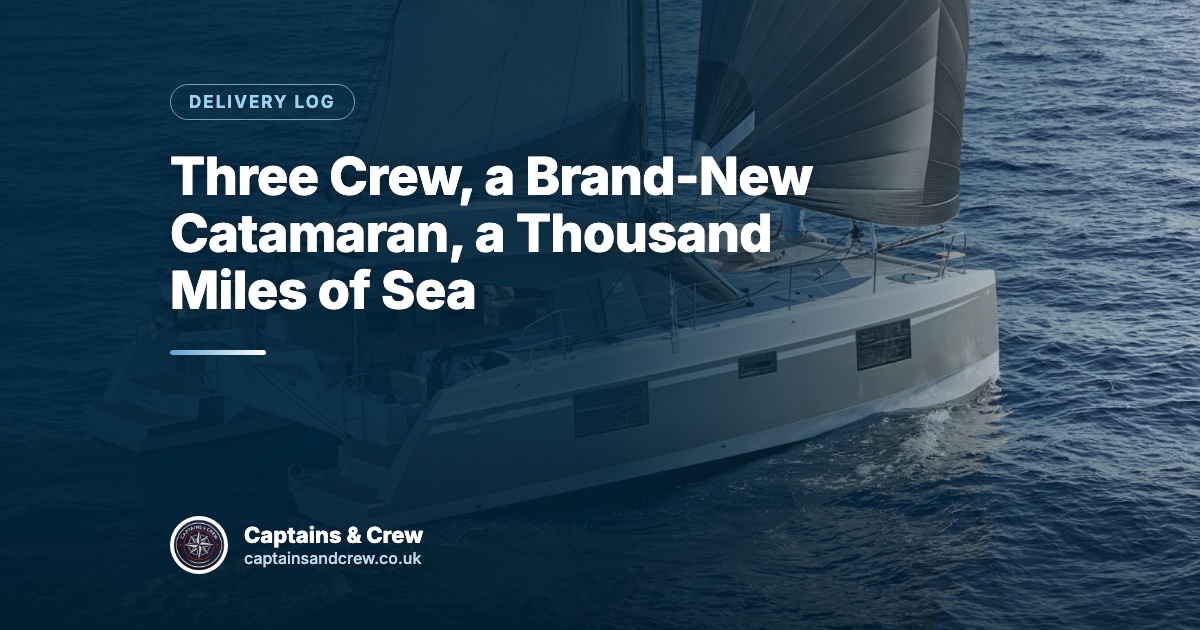
Three crew members. A brand-new catamaran straight from the yard. One thousand miles of open water. Our latest professional yacht delivery begins today.
Today we say farewell to home. Three of our crew are heading to La Rochelle — to take delivery of a catamaran fresh from the shipyard and bring her all the way to the Mediterranean.
Who the owner is stays confidential for now. It could be a dealer awaiting his new arrival, a charter company with weeks already booked, a private owner impatient to see her on the pontoon. What we can share is everything else — because our work begins long before the lines are cast off.
What “Catamaran Delivery to the Mediterranean” Actually Means
Moving a new catamaran from La Rochelle to the Mediterranean is not a sailing holiday. It is an operational mission, and it demands the same care and planning as a short ocean crossing.
The classic route takes you across the Bay of Biscay, south along the Atlantic coast of the Iberian Peninsula, through the Strait of Gibraltar, and then east into the Med. Several hundred miles, weather patterns that shift with every degree of latitude, and a vessel that must arrive at its destination exactly as it left the yard: pristine.
This is the standard route for any yacht delivery from the Atlantic to the Mediterranean, and it is one we know well. The Bay of Biscay in particular demands respect — conditions can change in hours, and a delivery crew that has crossed it before makes a measurable difference to how the boat arrives.
The Preparation Nobody Talks About
There is the part everyone sees — engine checks, sails, electronics, navigation systems, safety equipment, onboard gear. And then there is the part that rarely makes it into the debrief but makes all the difference between a delivery well done and one that leaves work for the yard on arrival.
Bubble wrap on interior furniture. Protective film on painted surfaces. Padding on every vulnerable edge. Every finish, every detail is treated like a museum piece being crated for shipping — because at sea, things happen. A beam sea, a sudden movement, an object that works loose, an unexpected wake. You can prevent a great deal. Predict everything? Impossible. After dozens and dozens of deliveries, the sea has taught us that much.
Pre-Departure Checks: What Our Delivery Crew Covers
- Full instrument verification — GPS, AIS, radar, autopilot, VHF radio: tested under load, not just powered on
- Engine systems — fluid levels, filters, raw water impellers, shaft seals, dynamic engine trial in the marina
- Onboard systems — fresh water, electrical, gas, refrigeration: leaks, pressures, function checks
- Safety equipment — life raft service date, EPIRB registration and function, flares in date, bilge pumps, jacklines and tethers
- Detailed weather planning — departure windows, intermediate refuge ports identified for every leg, grib files downloaded, router consulted
For a new build, this checklist also includes a systematic review of shipyard snags — items that look finished in the yard and reveal themselves in motion. We document everything before departure so nothing discovered at sea becomes an arrival dispute.
The Rule That Actually Keeps the Boat Safe
There is a running joke on our delivery crews — one we repeat every time and never quite stop believing: we will do everything for the crew first, for the boat second, for the delivery third. It sounds like a joke. It is not entirely one.
A rested crew, well fed, with watch rotations that are kept honestly, is the single most reliable guarantee that the boat arrives in perfect condition. A Bay of Biscay crossing is not something you improvise. You do not do it tired. You do not do it having underestimated the weather. You do not do it with bravado.
This is why every professional delivery crew operates on strict watch rotation — typically three hours on, six off for a crew of three, adjusted for conditions. Fatigue is the number one avoidable risk on any offshore passage. Managing it is not optional; it is part of the job.
Why Every Delivery Is Different
After dozens and dozens of deliveries — catamarans and monohulls, new builds and well-sailed veterans, short hops and ocean crossings — we can guarantee one thing with certainty: no two passages are ever the same.
The wind changes. The boat changes. The sea changes. The people onboard bring their own experience, their own instincts, their own way of reading the water. The surprises change too — and there are always surprises. That is not a warning. It is simply what offshore sailing is, and it is why experience matters more than any checklist.
What does not change is the commitment: to deliver the yacht we were entrusted with exactly as it was handed to us at the yard gate.
What Happens After La Rochelle
The full route looks like this: La Rochelle → Bay of Biscay → Spanish Atlantic coast → Gibraltar → Western Mediterranean → final destination. Approximately 1,000 nautical miles, depending on the precise endpoint. We will be posting updates from the water over the coming days.
If you are considering a similar delivery — a new catamaran from a French or Spanish yard, a repositioning from the Atlantic to the Mediterranean, or any offshore passage that needs a professional crew — see our yacht delivery services or read our guide on what a professional delivery costs. Or if you prefer to sail your own boat with a professional in command, our hire a skipper service covers exactly that.
→ Continue reading: Sailing Weather in 2024, 2025 and 2026: Why Route Planning Has Never Been Harder
Fair winds to us. We’ll be in touch from sea.